
Search Delaware Warrant Records
Delaware warrant records are tracked through a central state system and through local courts in each of the three counties. You can check warrant status online through the Delaware Criminal Justice Information System Wanted Persons Portal, search by name, or contact the court that issued the warrant. Most active warrants in the state appear in the online database. Some are only at the Superior Court, Court of Common Pleas, or Justice of the Peace Court that issued them. This page covers every main way to search Delaware warrant records, from the statewide portal to county sheriffs and city police.
Delaware Warrant Records Overview
How to Check Delaware Warrant Records
The fastest way to look up a Delaware warrant is through the DELJIS Wanted Persons Portal. You type in a last name, first name is optional, and the system returns any match. The portal covers warrants issued by the courts of Delaware. Recent changes may not show up right away. So if you see nothing, the warrant may have been cleared, or it may be brand new and not yet loaded.
The portal also warns you plainly: do not try to arrest anyone based on what you see. Only a sworn officer can do that. If you want to report a tip on someone wanted in Delaware, you can call Crime Stoppers at 1-800-TIP-3333 or use the online form at delaware.crimestoppersweb.com. Tips are anonymous and may pay a cash reward when they lead to an arrest.
Before you start a lookup, gather what you know. A full legal name helps. A date of birth narrows the search. The county where the person lives or was last in court is useful too. Most Delaware warrant records come out of one of the three county Superior Courts, the Court of Common Pleas, or a Justice of the Peace Court. Each of those feeds into DELJIS, so a clean name search usually picks up everything active.
The Delaware State Police ran a public notice encouraging residents to check their own status. That notice is at dsp.delaware.gov. The idea is simple. If you have a capias you didn't know about, it is better to find out at home than during a traffic stop. Many people turn themselves in and post bond the same day once they know.
Note: Do not rely on the public portal as your final word. Call the issuing court or a Delaware State Police troop to confirm warrant status before you act.
DELJIS Wanted Persons Portal
The Delaware Criminal Justice Information System is the state's main hub for warrant data. DELJIS shares records between police, courts, and corrections. The public side of DELJIS is the Wanted Persons Portal at pubsrv.deljis.delaware.gov. It is free. It is the first place to go for a name search.
A search there gives you the offender's full name, date of birth, race, sex, any known aliases, the charges tied to the warrant, and the court that issued it. That last piece is key. Once you see which court signed the warrant, you know where to call to confirm status or to arrange a surrender. The DELJIS homepage at deljis.delaware.gov also links to VINE, a custody alert service, and the state's ePayment system for court fines.
Here is what a good DELJIS search needs:
- Last name (required)
- First name (optional but helps)
- Approximate date of birth, if known
- County name for follow-up calls
Use DELJIS for a first pass. Then move to the court or troop.
Below is the public DELJIS Wanted Persons Portal, where you enter a name and check for active warrants and capiases issued by Delaware courts. The portal is described in detail at pubsrv.deljis.delaware.gov.
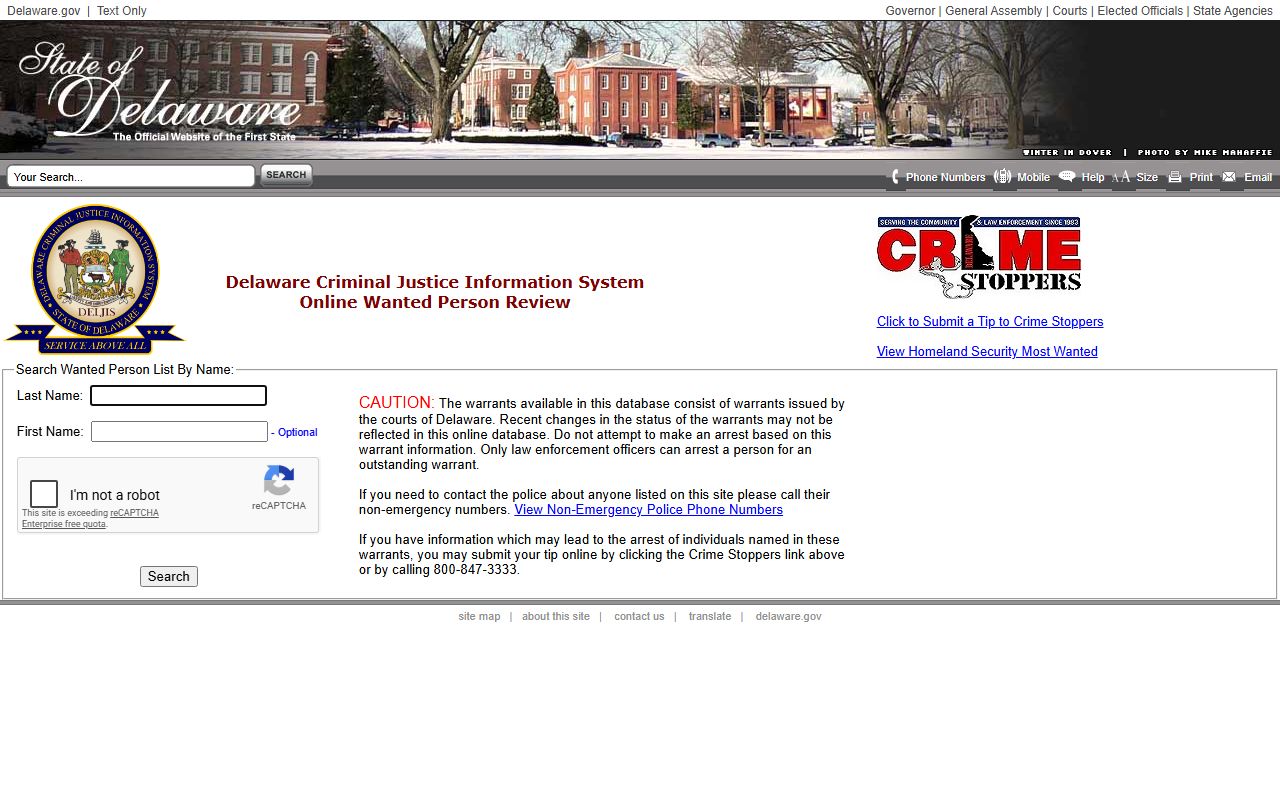
The portal returns records by last name. Type the name, review the list, and select a match to see charge details and the issuing court.
Delaware State Police and Warrant Enforcement
The Delaware State Police enforce warrants across all three counties. DSP runs seven troops. Each troop covers a part of the state and keeps its own records of active warrants in its area. The main DSP site at dsp.delaware.gov lists troop contact info and publishes news on warrant operations.
DSP also coordinates multi-agency warrant sweeps. A recent one in Kent County pulled in Troop 3, Milford Police, Camden Police, Smyrna Police, and Probation and Parole. Over two days the task force located 23 wanted people, served 18 warrants covering 194 criminal charges, and cleared 34 court capiases by arrest. These sweeps happen a few times a year and show how deep the warrant enforcement network runs in Delaware.
Lead details for DSP:
- Headquarters: 1447 N DuPont Highway, Dover, DE 19901
- Main line: (302) 739-5901
- Emergency: 9-1-1
- Search warrant news archive: dsp.delaware.gov/category/search-warrant
DSP press releases show warrant activity in Frankford, Dover, Harrington, Milton, Laurel, Milford, Wilmington, and many other towns. Drug and firearm charges drive most felony warrant work. The Governor's Task Force, county drug units, and DSP Special Operations Response Team often work these cases together.
Below is the Delaware State Police homepage, the main portal for statewide warrant enforcement and troop locations. Access it at dsp.delaware.gov.
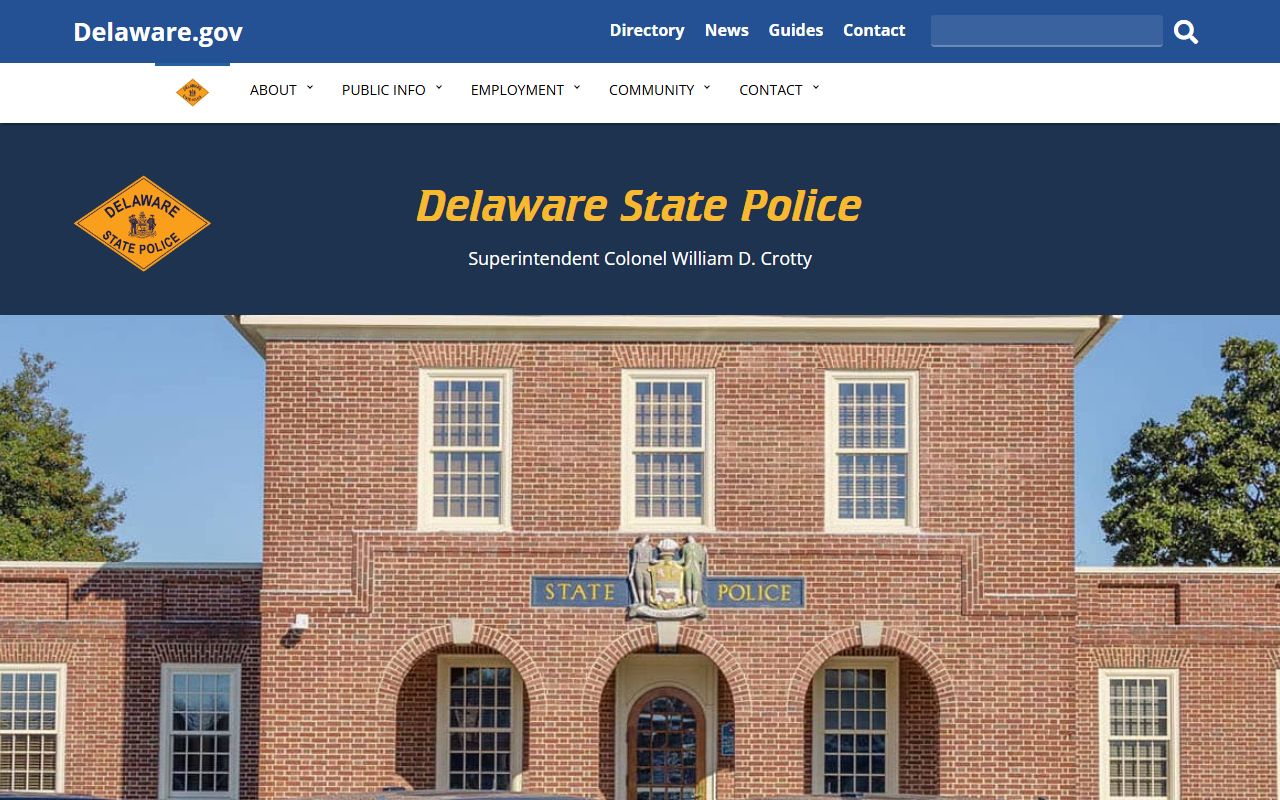
Use the troop directory to reach the right agency for a warrant question in your area.
Types of Warrants in Delaware
Delaware uses several kinds of warrants. Each one has its own trigger and its own path through the court. Knowing the type helps you know where the record lives.
An arrest warrant comes out when police and a judge agree there is probable cause that someone committed a crime. The rules are in Delaware Code Title 11, Section 2104, posted at delcode.delaware.gov/title11. A bench warrant is different. A judge issues it from the bench when someone fails to appear or violates a court order. Bench warrants go into DELJIS right away and any officer in the state can act on them.
A capias is close to a bench warrant. Delaware courts, especially the Court of Common Pleas and the Justice of the Peace Court, lean on the capias for failure-to-appear cases. Capias pro fine is a specific form used when someone does not pay ordered fines. Turning yourself in on a capias often resolves the case the same day with a new court date or a payment plan.
Search warrants authorize entry into a home, a car, a storage unit, or another place named in the warrant. Delaware Code Title 11, Section 2306 sets the rules. Search warrants must be executed within 10 days and returned to the court with an inventory of what was seized. Body attachments are civil warrants. Courts issue them for contempt, failure to pay child support, or failure to answer a subpoena. The Sheriff's Office in each county handles most body attachments.
Heads Up: If you have an active warrant and contact police in person, you may be taken into custody on the spot. Call an attorney before you walk into a station to ask about your own status.
Delaware Court Systems and Warrant Records
Delaware has a layered court system, and each layer generates warrant records. The Superior Court handles felonies and appeals. The Court of Common Pleas handles misdemeanors and civil cases up to $75,000. The Justice of the Peace Court is the entry point for most cases, including initial appearances and minor offenses. Each court issues its own bench warrants and capiases.
CourtConnect is the online docket system for Delaware courts. It is at courtconnect.courts.delaware.gov. The portal covers civil, criminal, and traffic cases in Superior Court, Common Pleas, and JP Court. You can search by name, business name, case number, or case type. A public docket entry often reveals a pending bench warrant, a capias, or a case status that hints at warrant activity. The docket search is free, though not all dockets show up.
The Delaware Courts page at courts.delaware.gov/docket.aspx explains the system and links to the newer portal. Superior Court felony warrants, Court of Common Pleas misdemeanor warrants, JP Court failure-to-appear capiases, Family Court contempt body attachments, and Alderman's Court municipal warrants all have separate clerks and separate record-keeping.
Below is the CourtConnect portal, the central online docket search for Delaware warrant research and case lookup. It's available at courtconnect.courts.delaware.gov.
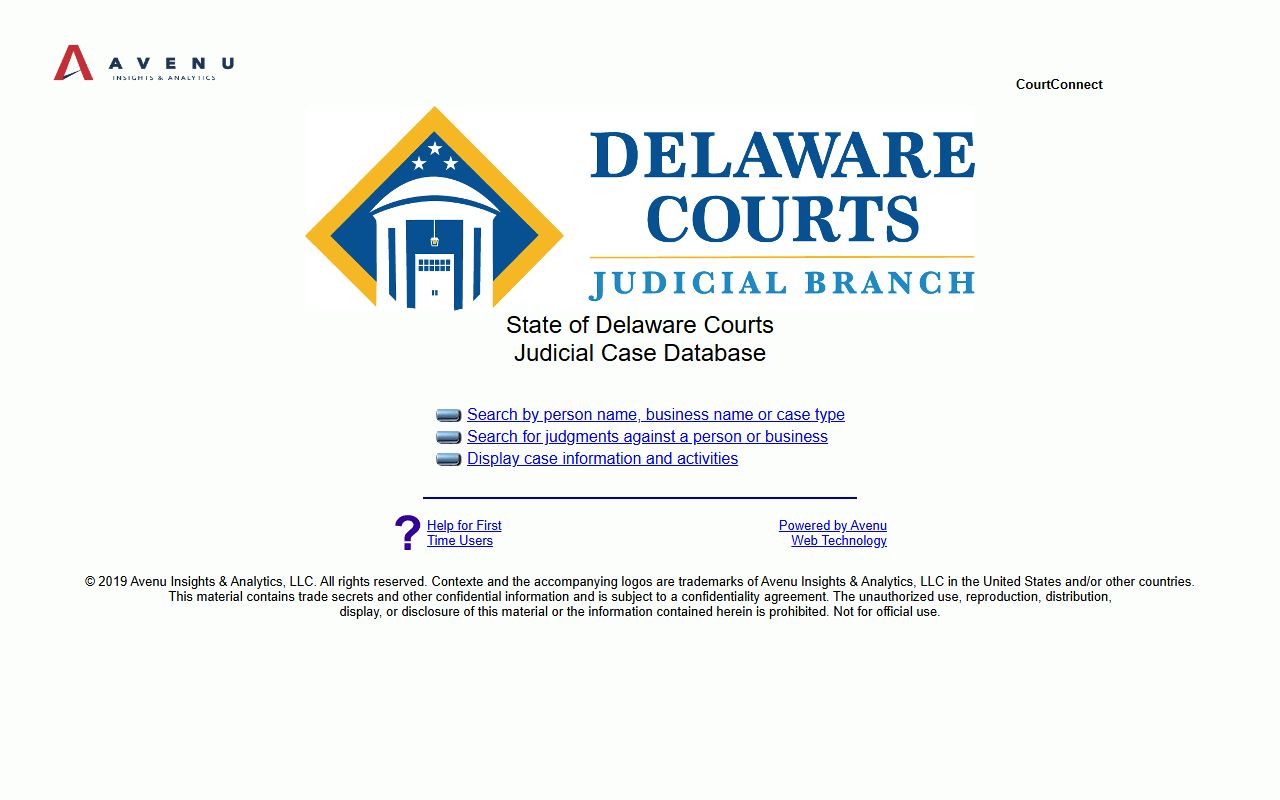
Use CourtConnect to pull a docket by name or case number, then note the court and case activity for follow-up.
The Delaware Courts Civil Case Search at courts.delaware.gov/docket.aspx is the legacy docket page. It still works for older cases. If a warrant stems from a civil contempt matter, this is a good second stop.
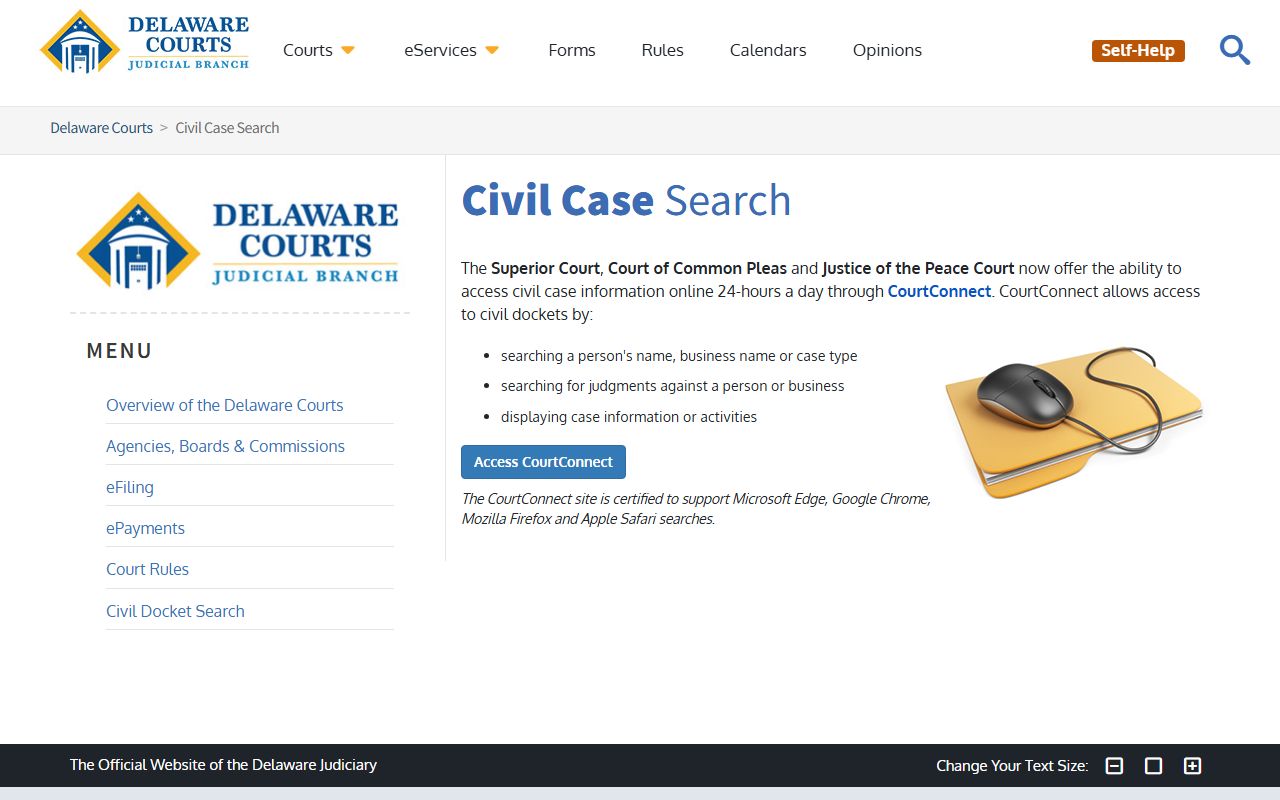
The page supports Microsoft Edge, Chrome, Firefox, and Safari. Search by party, business, or case type.
Federal Warrants in Delaware
Federal warrants run on a separate track from state warrant records in Delaware. The U.S. District Court for the District of Delaware issues federal arrest and search warrants. The court sits at the J. Caleb Boggs Federal Building, 844 N. King Street, Unit 18, Wilmington, DE 19801. Main line: (302) 573-6170. The site is ded.uscourts.gov.
Federal warrants are enforced by the U.S. Marshals Service, the FBI, DEA, ATF, and other federal agencies. The Delaware U.S. Marshals Service office is at 844 King Street, Suite 4301, Wilmington. Main line: (302) 573-6176. PACER is the way to look up federal case dockets. It charges a small fee per page but shows most filings.
Below is the U.S. District Court for Delaware, which handles federal warrant records and cases filed under federal law. Details are at ded.uscourts.gov.
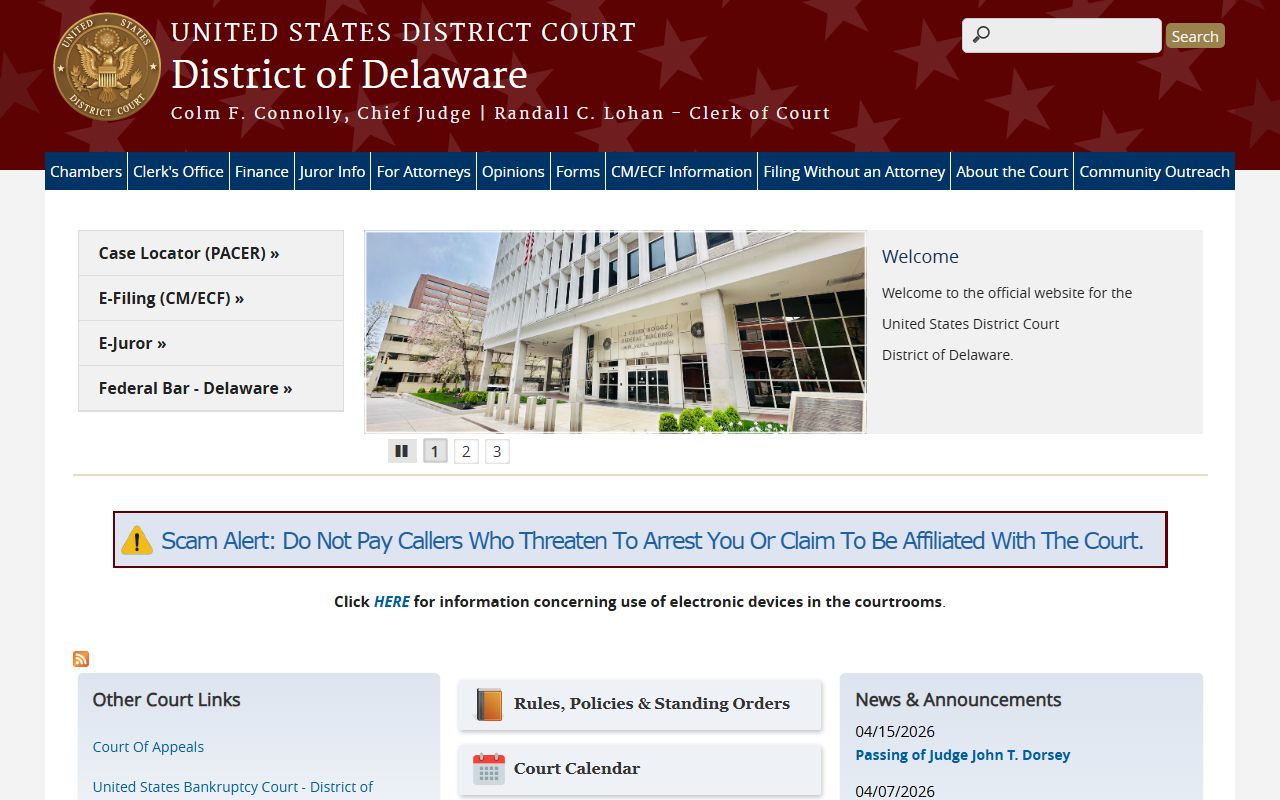
Check PACER for a federal case with a warrant. Or call the Clerk's Office if the case is new and not online yet.
FOIA and Warrant Records Requests
Delaware's Freedom of Information Act, codified at 29 Del. C. Chapter 100, lets the public request records from state and local agencies. Warrant records are sometimes exempt, but many related records are available. The main FOIA page is at delaware.gov/foia. You can file online, by email, by mail, or in person.
Steps for a Delaware FOIA request:
- Pick the right agency (DSP, DOC, a county sheriff, a city police records unit)
- Write a clear, narrow request with names, dates, and report numbers if you have them
- List a cost cap so you don't get hit with a big bill
- Submit and wait up to 15 business days for a response
Common exemptions cut into warrant record disclosure. Investigatory files for law enforcement, pending litigation records, and files that would invade personal privacy are all blocked. Still, you can often get an incident report, a warrant service return, or a press release tied to a warrant sweep. The Department of State handles many agency FOIA requests through sos.delaware.gov/contact/foia-requests.
Below is the state's FOIA Request Form page, which explains the process and provides the online request portal. Access at delaware.gov/foia.
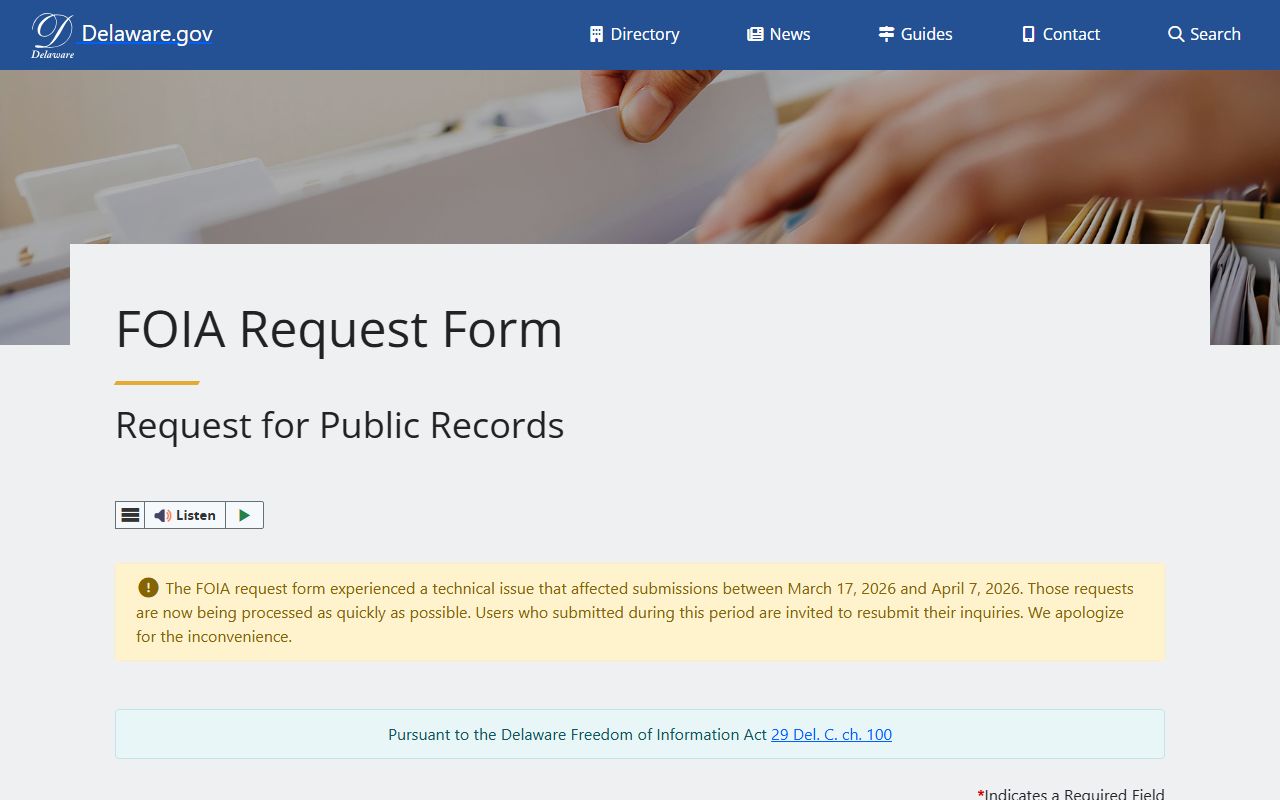
The form takes your name, the records you want, the format, and your cost threshold. Save the confirmation.
The Department of State FOIA page at sos.delaware.gov is a separate portal for records held by Department of State agencies.
Use the Department of State portal for state-level agency records. County and city records go through the local FOIA coordinator.
Department of Correction and Custody Status
Sometimes a person with an active warrant has already been arrested. The Delaware Department of Correction runs an offender locator that shows who is in custody. The main DOC page is doc.delaware.gov. The locator pulls data from every state facility.
Primary Delaware correctional facilities:
- Howard R. Young Correctional Institution (Wilmington)
- James T. Vaughn Correctional Center (Smyrna)
- Baylor Women's Correctional Institution (New Castle)
- Sussex Correctional Institution (Georgetown)
VINE, the Victim Information and Notification Everyday service, works alongside DOC. It sends alerts on custody changes. A warrant status check plus a VINE lookup gives a full picture of where someone stands in the system.
Below is the Delaware Department of Correction page, which hosts the offender locator and facility directory used during warrant records research. Go to doc.delaware.gov.
Search by name. The result shows facility, status, and projected release date if an inmate is active in DOC custody.
Criminal History and Attorney General's Office
The Delaware Attorney General's Office prosecutes all state criminal cases, including every case tied to an active warrant. The AG site is attorneygeneral.delaware.gov. Specialized units include Homicide, Violent Criminal Enterprise, Child Predator, Domestic Violence, and Special Victims.
The Delaware DOJ acts as the state's largest law firm, with 220 attorneys. The Criminal Division covers all three counties through offices in New Castle, Kent, and Sussex. When a warrant leads to an arrest, a deputy AG handles the charging decision, the bond argument, and the trial if the case goes that far. A Consumer Protection hotline at 800-220-5424 helps with fraud tips that can lead to warrants.
Below is the Delaware Department of Justice homepage, which houses prosecutor contact info for each Delaware warrant records case. View at attorneygeneral.delaware.gov.

Reach the deputy AG by county. The site also lists victim services contacts, who can help track a case tied to a warrant.
The State Bureau of Identification handles fingerprint background checks and criminal history reports. A certified Delaware record costs $72. A combined Delaware and federal report runs $85. Appointments go through IdentoGO. The SBI maintains the central repository for Delaware warrant records attached to criminal history, so a certified report is often the most complete record you can get about yourself.
Public Notice on Checking Warrant Status
In 2019 the Delaware State Police issued a public notice urging residents to check their own warrant status. The notice still stands. People often have capiases from old JP Court matters or failure-to-pay cases and do not know. The notice page at dsp.delaware.gov/2019/01/04/check-wanted-status-delaware lays out the reasons and the lookup steps.
The main message from DSP: find out now, not later. An active warrant travels with you. A traffic stop in Sussex County can land you in custody on a Kent County capias. Knowing your status gives you the chance to go to the issuing court on your terms and settle the matter.
Below is the DSP announcement on checking your own warrant status in Delaware. It explains the process and links to the DELJIS search tool. See it at dsp.delaware.gov.
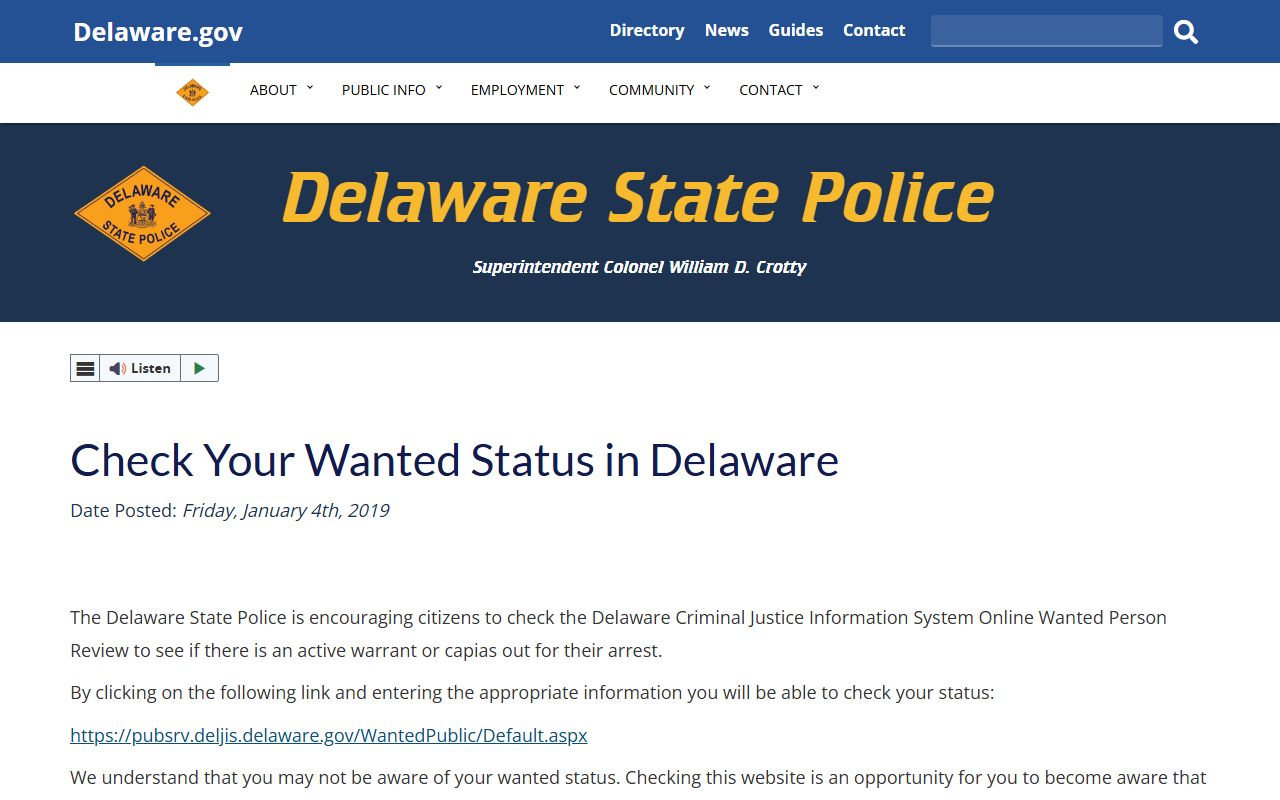
The announcement also instructs citizens to contact the agency that issued the warrant and turn themselves in to resolve the matter quickly.
DELJIS Homepage and Services
The DELJIS homepage at deljis.delaware.gov is the gateway to the public side of Delaware's criminal justice information system. Beyond the Wanted Persons Portal, it links to ePayment for court fines and VINE for custody alerts. DELJIS protects privacy on the back end while giving the public a narrow, name-based lookup for active warrant records.
Below is the DELJIS homepage. It lists the main public services and links to the warrant records portal. View it at deljis.delaware.gov.
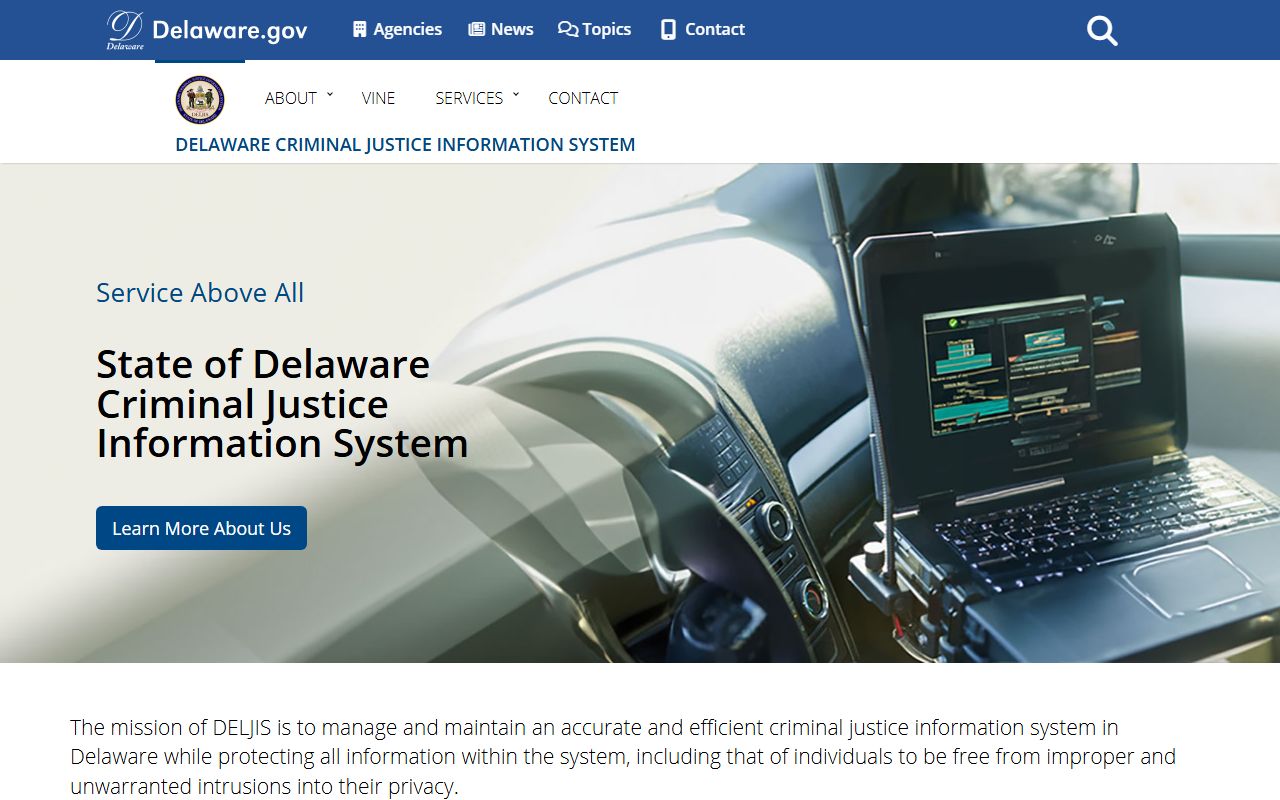
Bookmark the page. It is the fastest route to the Wanted Persons Portal and to the state payment system for clearing a capias pro fine.
Browse Delaware Warrant Records by County
Delaware has three counties. Each runs its own Sheriff's Office, Superior Court, and Court of Common Pleas. Each county also has its own pattern of warrant activity, FOIA procedures, and State Police troop coverage. Pick a county below to find local contact info, court addresses, and warrant records resources.
Warrant Records in Major Delaware Cities
Most Delaware warrant records start at a city police department or a Justice of the Peace Court. If you want to focus on one city, pick it below for local police, court, and FOIA details.